
Your Van Isle Home Blog

The latest real estate market trends, mortgage updates, homeowner tips, and community finds.

RSS

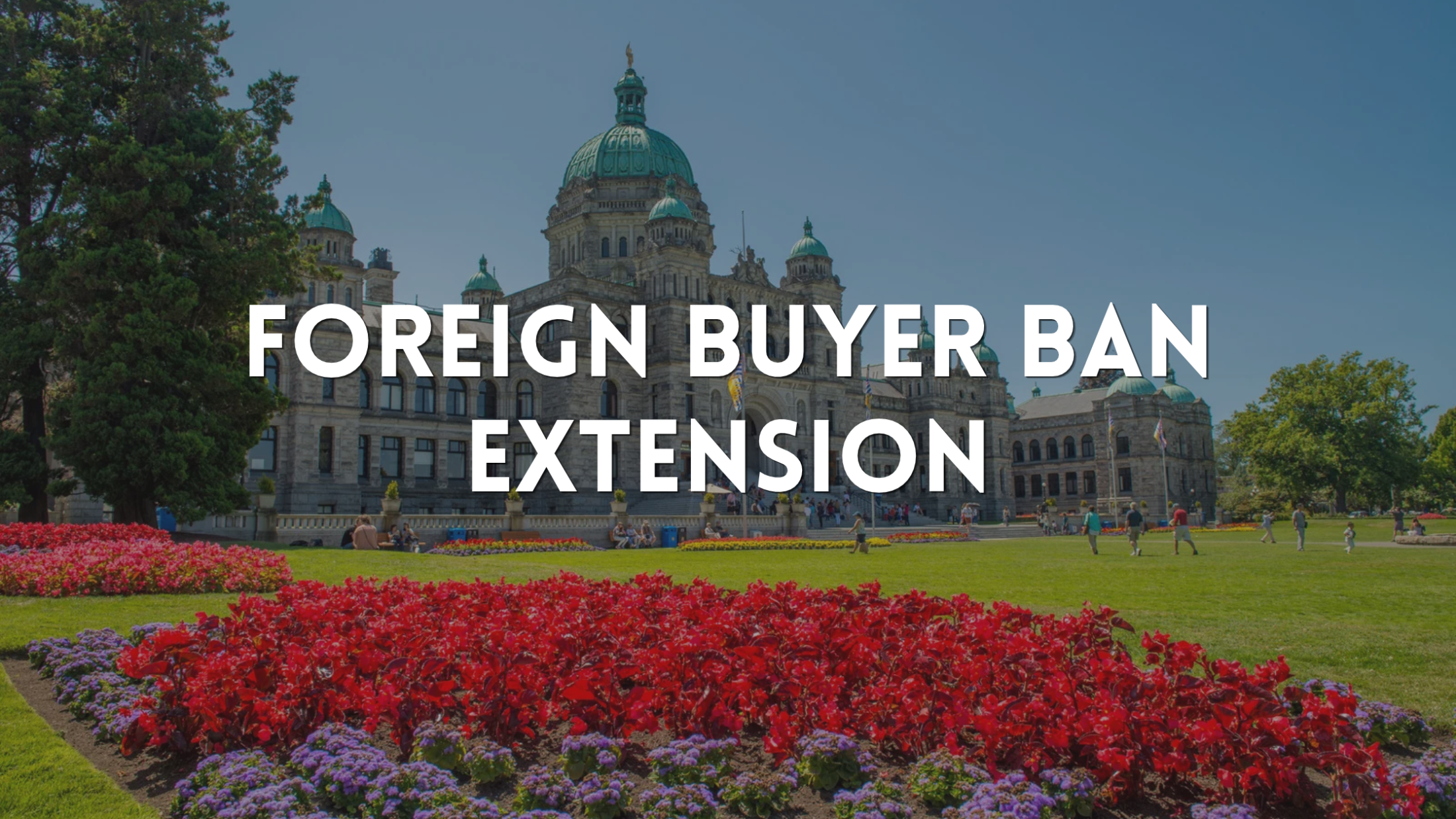
What the Foreign Buyer Ban Extension Means for Victoria

If you've caught the headlines since the federal budget came out on November 5, you might be wondering whether foreign buyers are about to return to the Victoria market. It's a fair question, and the short answer is that nothing has changed yet. I've lived in 26 homes and moved from Toronto to Victoria myself, so I know how unsettling it can feel when the rules seem to shift while you're planning your next chapter.

Here's what's been proposed, what it could mean here on the Island, and what we're still waiting to learn.

What's Been Proposed

Canada's foreign buyer ban came into effect on January 1, 2023, and it's currently set to expire on January 1, 2027. Budget 2026 proposes to keep the ban on existing and resale homes for two more years, until January 1, 2029. It also proposes to exempt newly built homes, which means some buyers who can't purchase here today could become eligible to buy new construction. The government's stated goal is to keep existing homes available for Canadians while encouraging investment in new housing.

It's important to know that none of this is law yet. Ottawa still has to pass legislation and set out regulations, and today's restrictions stay in place in the meantime. Because the current ban ends on January 1, 2027, the extension would need to pass before then.

What We're Still Waiting to Learn

The budget doesn't define what counts as a newly built home. We don't yet know whether presale contracts signed before a building is finished would qualify, or whether completed new homes that haven't sold would be included. There's also no start date for the exemption.

Those answers will shape who this helps and how quickly. Until the rules are published, no one should assume a new construction purchase is permitted just because an exemption has been announced.

BC's 20% Foreign Buyer Tax Still Applies

For those of us in Greater Victoria, this may be the most important part of the story. BC charges an additional 20% property transfer tax on foreign nationals, foreign corporations and certain taxable trustees who buy residential property in designated areas. The Capital Regional District is one of those areas, and it includes Victoria, Saanich, Oak Bay, Langford, Sidney and the communities around them. Because this tax is provincial, a federal exemption wouldn't remove it.

As an example, on a newly built $800,000 condo in Victoria, the additional tax would be $160,000, bringing the total to $960,000 before regular property transfer tax, GST and other closing costs, assuming no provincial exemption applies. Community planner Michael Geller told Global News that he expects this tax to keep deterring many foreign buyers, even if the federal rules loosen.

It's also easy to mix this up with BC's Newly Built Home Exemption, which is a separate program. That one can reduce or eliminate regular property transfer tax for buyers who meet residency, occupancy and other requirements, and it has nothing to do with whether someone is allowed to buy under the federal rules.

If You're Downsizing

If you're selling an existing home, this proposal wouldn't change who can buy it. The people who are eligible to purchase your home today would be the same people who are eligible next year. If you're a Canadian citizen or permanent resident looking at a new condo or townhome for your next chapter, the ban doesn't apply to you, so your options stay as they are.

It's too early to say whether more foreign buyers would show interest in new developments here, especially with the 20% tax in place. I wouldn't change your timing based on this news alone. Your plans, your health, your family and the right home in the right neighbourhood are much better reasons to move or to wait.

If You're Relocating to the Island

If you're moving here from Toronto, Vancouver or anywhere else in Canada as a citizen or permanent resident, the ban doesn't affect you. You can keep exploring neighbourhoods and getting to know the community with the same options you had last month.

If you're coming from outside Canada, the current rules already include exceptions for some temporary residents, protected persons and others who meet specific requirements. Those exceptions are separate from the proposed new home exemption, so please confirm your eligibility before you enter into a purchase agreement.

What It Could Mean for New Homes Here

Developers often rely on presales to show demand and secure construction financing. A wider pool of eligible buyers could help some projects move ahead, which matters in a region where housing supply and affordability remain ongoing concerns. The real effect will depend on the final regulations, how much foreign demand exists, and BC's continuing tax rules.

Before Anyone Signs

Presale agreements are often signed long before a home is complete, so the details matter. If you're considering a purchase that could be touched by these rules, a real estate lawyer can review your federal eligibility, the tax picture and whether the contract addresses regulatory change, financing and completion. I'm always glad to connect you with someone local you can trust.

Headlines like this one can make a big decision feel more complicated than it needs to be. If you'd like to talk through what this means for your home, your neighbourhood and your timing, I'm here whenever you're ready. You can reach me at 250-415-5656 or jac@yourvanislehome.com.

This post reflects the changes proposed in Budget 2026, as of November 9, 2026, and those details may change before they become law. It's general information and isn't legal or tax advice.

Jacqueline Ross, REALTOR®
Your Van Isle Home
call/text: 250-415-5656
jac@yourvanislehome.com

Instagram | Facebook

Read

Victoria Real Estate Market Update: October 2026

A month ago, the headlines were all about Victoria tipping into a buyer's market, but that was never the whole picture. October's numbers brought the region back to balanced, and what you'll find really depends on the neighbourhood and type of home you're looking at. Some areas may still favour buyers, while others are showing a much more balanced market. I was in three different multiple offer situations myself in October alone, so I know firsthand how much can be happening beneath a regional headline. Add in the Bank of Canada's first rate increase in more than three years, and there's a lot to sort through. Let's look at what actually changed and what it means for your next move.

October at a Glance

  • 573 properties sold, down 7.1% from October 2025 and up 23.8% from September

  • 3,594 active listings, down 5.7% from September and up 5% from last year

  • 1,138 new listings, above the five year average of 1,060

  • Victoria Core single family benchmark of $1,288,600, up 0.7% from last year

  • Victoria Core condo benchmark of $533,900, down 2.8% from last year

  • Bank of Canada overnight rate of 2.50%, up a quarter point on October 28

Sales Picked Up From a Quiet September

A total of 573 properties sold across the Victoria Real Estate Board region in October. That's 7.1% fewer than the 617 sold last October, but 23.8% more than in September. Single family home sales fell 13.4% year over year with 303 sold, and condo sales fell 15.1% with 135 units sold. Townhomes went the other way, up 20% with 90 sold.

The bigger story is how ordinary that total is. October's sales were very close to the five year average of 581, while new listings came in a little higher than usual at 1,138. After September's slowdown, it's a reminder that one month rarely tells the whole story.

There were 3,594 active listings at the end of the month, down 5.7% from September and up 5% from this time last year. Inventory has come down from its June peak, but there's still a healthy number of homes to choose from.

Prices by Area and Type

Benchmark prices moved in different directions depending on where you're looking and what kind of home you own. Here's how each part of the region compared to October 2025.

Single Family Homes

Victoria Core: $1,288,600, up 0.7% year over year

Westshore: $1,006,300, down 1.2% year over year

Peninsula: $1,256,700, down 1.0% year over year

The Core was the only area to gain ground, up from $1,280,100 in September. The Westshore saw the largest monthly dip at 1.3%, while the Peninsula slipped just 0.3%.

Condos

Victoria Core: $533,900, down 2.8% year over year

Westshore: $489,000, down 3.4% year over year

Peninsula: $655,100, up 5.8% year over year

The Core fell from $547,800 in September, a noticeable drop for a single month, while the Westshore rose 2.1% and the Peninsula rose 2.4%. Benchmarks can shift from month to month, so I'd treat this as a direction rather than a verdict. Still, the Peninsula's 5.8% gain over the past year is worth noting if you're a downsizer looking at Sidney and the surrounding communities.

Townhomes

Victoria Core: $824,800, down 2.1% year over year

Westshore: $693,500, down 0.7% year over year

Peninsula: $822,500, down 0.5% year over year

Townhome benchmarks slipped slightly in all three areas, even as sales rose 20% from last year. Fewer townhomes sell each month, so a handful of sales can move these numbers more than usual.

What a Balanced Market Actually Means

September's data pointed to a buyer's market for the first time in years, and October moved us back to balanced. VREB Chair Fergus Kyne was careful to say that a single month doesn't establish a trend, and that much of 2026 has been relatively balanced. October proved his point.

A balanced market doesn't mean every home or neighbourhood is behaving the same way. Kyne also noted that conditions can vary considerably between areas and property types, and that some may continue to favour buyers. That's why the regional headline is only a starting point.

The Bank of Canada Raised Rates

On October 28, the Bank of Canada raised its overnight rate by a quarter point to 2.50%. It's the first increase since July 2023, and it ended a year of holding at 2.25%. Canada's inflation rate rose to 3.1% in September, driven largely by gas prices, and the Bank now expects inflation to stay above 3% through much of 2027.

The Bank's concern is that higher energy costs could spread into broader inflation. Governor Tiff Macklem said further increases may be needed, but that the Bank will proceed carefully and take its decisions one meeting at a time. The next announcement is December 9.

What this means for you depends on the kind of mortgage you have. With a variable rate mortgage, your rate rises when your lender raises its prime rate, which can mean a higher regular payment. If your payment is fixed, it may stay the same at first, with more going toward interest and less toward principal. If you reach your trigger rate, though, your lender may require you to increase it. Home equity and other lines of credit tied to prime will rise too.

If you have a fixed rate mortgage, your rate and payment won't change during your current term. Rates on new fixed mortgages can still move, but they don't automatically follow the Bank's rate. For a sense of scale, a quarter point adds about $62 a month at today's lowest variable rates on a $500,000 purchase with 10% down and a 25 year amortization.

If a first home is on your list, or you're hoping to help an adult child get there, December 31 is a date worth noting. Contribution room in a First Home Savings Account only starts building once you open one, even if you don't put anything in yet. Open an account in 2026 and you could have $16,000 of room in 2027, compared with $8,000 if you wait until January. Opening one also starts a maximum 15 year participation period, so it's worth thinking through your timeline first.

Every household is different, so what works for your neighbour may not be the right fit for you. Whether you're renewing, buying, or planning ahead, I'm always happy to connect you with a great mortgage broker who can help you understand your own financial options.

Population Growth Is Still Nearly Flat

Statistics Canada's latest estimates show BC's population grew by just 0.1% between July 2025 and July 2026, the slowest of any province. That continues to soften demand in the rental and entry level condo markets. At the same time, more British Columbians are reaching retirement age, which I see in my work with downsizers thinking carefully about their next chapter.

Financial Pressures Are Still Real

Higher gas prices and a rate increase are landing on household budgets that are already stretched. CMHC estimates about 1.15 million Canadian mortgages will renew this year, with another 940,000 next year. If you have a renewal coming up, starting the conversation early gives you more options and less stress.

Looking Ahead

The rate increase came at the very end of the month, so October's sales don't really reflect it yet. November and December will give us a better read on how buyers respond. The next inflation report arrives on November 16, followed by the Bank's decision on December 9.

Inventory also tends to taper through the winter, so today's level of choice may not carry into the new year. For anyone relocating from Toronto or Vancouver, that makes this a good time to get to know our neighbourhoods. Having made that move myself, I know how much easier it feels when you have time to find the right fit.

What This Market Means If You're Buying

  • You still have choice. With 3,594 listings available, you have time to compare homes and neighbourhoods carefully.

  • Get your financing sorted early. A mortgage broker can walk you through your options and whether a rate hold makes sense.

  • Budget for more than the rate. Payments, strata fees, insurance, and everyday costs all matter to your comfort in a new home.

  • Look closely at condos. The Core and Westshore condo benchmarks have eased over the past year, which may open up options for downsizers.

  • Think locally. Some neighbourhoods and property types may still favour buyers, even in a balanced market.

What This Market Means If You're Selling

  • Price for today's market. Buyers have other homes to compare yours to, and they're taking the time to do it.

  • Preparation counts. With new listings running above average, a well presented home makes a real difference.

  • Know your segment. Benchmarks moved in different directions by area and property type in October, so your plan should reflect your own home.

  • Plan both sides of your move. If you're downsizing in the same market, softer conditions can work in your favour on the purchase side.

  • Think about timing. Inventory often tapers in winter, but what matters most is whether the timing works for your life.

Thinking About Your Next Move?

Every neighbourhood and property type is behaving a little differently right now, and the headlines don't tell the whole story. Whether you're buying, selling, downsizing, or simply curious about what your home is worth, I'm happy to walk you through what these numbers mean for your situation.

Jacqueline Ross, REALTOR®
Your Van Isle Home
call/text: 250-415-5656
jac@yourvanislehome.com

Instagram | Facebook

Read

Talking With Family About Downsizing Over the Holidays

The holidays have a way of bringing everyone back around the same table. There's food, laughter, old stories, and often a quiet moment when someone looks around the family home and wonders what the next few years might look like. If you've been thinking about downsizing, this season can be a natural and gentle time to start that conversation.

I've helped many families through this transition, and I've moved 26 times myself, so I know how much emotion can live inside a home. The good news is that a thoughtful conversation now can make the whole process feel calmer and more connected later. Here are a few ways to approach it with care.

Why the Holidays Can Be a Good Time to Talk

When family is together in person, conversations tend to feel more relaxed and more honest than they do over the phone. Everyone can see the home, talk about what's working and what isn't, and share ideas face to face. There's also no pressure to make a decision on the spot. The new year is still ahead, which leaves plenty of time to plan a spring move at a comfortable pace.

Start With the Why, Not the When

It's easy to jump straight into timelines and prices, but most families respond better when the conversation starts with what you're hoping for. Maybe you'd love fewer stairs, less yard work, or a home closer to the grandkids. Maybe you're ready for a walkable neighbourhood where you can stroll to a café or the pharmacy. Sharing your reasons first helps everyone understand that this is about your next chapter, not about letting go of the past.

Choose a Calm Moment

The middle of a busy holiday dinner probably isn't the best time. A quiet coffee the next morning or a walk after a meal often works far better. If you have several family members to include, consider letting everyone know ahead of time that you'd like to chat about some plans. That way nobody feels caught off guard.

Listen as Much as You Share

Adult children can have strong feelings about the family home, even if they haven't lived there in years. It may hold memories of first days of school, birthday parties, and holidays past. Give them room to share those feelings. Listening doesn't mean you have to change your plans, but it helps everyone feel heard and makes it easier to move forward together.

Talk About What Matters Most

A good downsizing plan starts with knowing your priorities. These are some of the topics families often find helpful to discuss together:

  • Which neighbourhoods feel right, and how close you'd like to be to family, friends, and your favourite local spots

  • What type of home suits your lifestyle, whether that's a condo, a townhome, a rancher, or a home in a 55+ community

  • How much space you really need for hobbies, visiting family, or a home office

  • Which belongings matter most, and which treasures family members might like to keep

  • Whether buying first or selling first makes more sense for you

You don't need answers to all of these right away. Simply naming them gives everyone a shared starting point.

If You're the Adult Child Starting the Conversation

Sometimes it's the kids who notice that a home has become more work than it used to be. If you're raising the topic with your parents, lead with care and curiosity rather than solutions. Ask how they're feeling about the house and what they'd love their days to look like in a few years. Let them guide the pace. A conversation that feels respectful is far more likely to lead somewhere positive than one that feels like a plan has already been made for them.

Expect Mixed Feelings

Excitement and sadness can show up in the same conversation, and that's completely normal. Leaving a home you love is a big change, even when the next home is the right fit. Give yourself and your family permission to feel both. Many of my clients tell me that once they're settled, they wish they'd made the move sooner, but that perspective usually comes with time.

Keep It a Conversation, Not a Decision

The goal of a holiday chat isn't to sign anything or set a moving date. It's to open the door. Once everyone is comfortable with the idea, the next steps can unfold gradually over the winter. That might mean learning what your home is worth today, looking at a few neighbourhoods together, or starting to sort through belongings one room at a time.

Your Next Step

If you'd like a simple place to start, my free Smart Downsizing guide walks you through practical steps to help you plan your move with confidence. It's a helpful resource to share with family, too. And whenever you're ready, I'm always happy to meet for a relaxed conversation about your options. There's no pressure and no timeline other than the one that feels right for you.

Download your free Smart Downsizing guide here, or reach out anytime.

Jacqueline Ross, REALTOR®
Your Van Isle Home
call/text: 250-415-5656
jac@yourvanislehome.com

Instagram | Facebook

Read

Victoria Real Estate Market Update: September 2026

If you've been out walking your neighbourhood lately, you may have noticed a few more For Sale signs than usual, and some of them staying up a little longer. That observation lines up with the numbers. September was the month Greater Victoria's market quietly shifted, and it's worth understanding what changed and what didn't before reading too much into the headlines.

Sales Slowed Noticeably in September

A total of 463 properties sold across the Victoria Real Estate Board region in September. That's down 16.4% from September of last year and 21.7% lower than August. Single family home sales fell 17.3% year over year with 239 sold, while condo sales dipped 11% with 137 units sold. Townhomes saw the biggest pullback, down 26.4% with 53 sold.

At the same time, inventory kept building. There were 3,811 active listings at the end of the month, up 4.1% from August and 3.2% higher than this time last year. More homes to choose from and fewer buyers making moves is the combination that tips a market in the buyer's favour.

Prices by Area and Type

Benchmark prices softened slightly in most areas, but the story varies depending on where you're looking and what kind of home you own. Here's how each part of the region compared to September 2025.

Single Family Homes

Victoria Core: $1,280,100, down 2.0% year over year

Westshore: $1,019,800, down 1.2% year over year

Peninsula: $1,261,000, down 1.4% year over year

The Peninsula held up best over the past month, slipping only 0.4% from August. The Core saw the largest monthly adjustment at 1.7%, which is still a modest move for a market of this size.

Condos

Victoria Core: $547,800, up 1.0% year over year

Peninsula: $639,900, up 3.4% year over year

Westshore: $478,800, down 4.0% year over year

Peninsula condos were the only benchmark in the entire report to rise from August, up 1.5% in a single month. For downsizers looking at Sidney and the surrounding communities, that tells me demand for low maintenance living close to the water is holding steady.

Townhomes

Victoria Core: $829,400, down 1.7% year over year

Westshore: $703,100, down 0.8% year over year

Peninsula: $828,100, up 0.9% year over year

Townhomes gave back some of the gains they showed last month, with the Core dipping 3.1% from August. Because fewer townhomes are selling overall, a handful of sales can move these numbers more than usual, so I'd treat them as a direction rather than a verdict.

What a Buyer's Market Actually Means

The sales to active listings ratio dropped to roughly 15% in September. Based on research by the BC Real Estate Association, anything below 17% points to downward pressure on prices, which is how a buyer's market is defined in Victoria. VREB Chair Fergus Kyne noted that outside the early pandemic months, this is the first buyer's market we've seen here since January 2015.

He was also quick to add that one month doesn't make a trend, and I agree. September looked very different from July and August, and October could look different again. What I'm hearing in my own conversations is that buyers are taking their time, asking good questions, and feeling less pressure to compromise. Sellers who are priced for today's conditions are still finding buyers, but the margin for overpricing has gotten much smaller.

Inflation and Mortgage Rates

Canada's inflation rate held at 3.0% in August for the second month in a row, driven largely by gasoline prices. The Bank of Canada's preferred core measures sit much closer to its 2% target, which gives the Bank room to stay patient. The overnight rate has held at 2.25% since October 2025, and the next announcement comes at the end of October.

If you're wondering how today's rates would affect a purchase or an upcoming renewal, I'm always happy to connect you with a mortgage broker I trust. Looking at your whole financial picture is what gives you real clarity, and the rate is only one part of it.

Population Growth Has Nearly Stalled

Statistics Canada's latest estimates show BC's population grew just 0.1% between July 2025 and July 2026, the slowest of any province. The number of non-permanent residents in BC also kept declining, which continues to soften demand in the rental and entry level condo markets. At the same time, the share of British Columbians aged 65 and older rose to 21.1%. That's a trend I see every day in my work with downsizers who are thinking carefully about what their next chapter should look like.

Financial Pressures Are Still Real

Many homeowners are renewing their mortgages at rates well above what they locked in a few years ago, and that adjustment is showing up in household budgets across the region. If you have a renewal coming up in the next year, starting the conversation early gives you more options and less stress. A calmer market is a good time to review where you stand, rather than waiting for a deadline to make the decision for you.

Looking Ahead

Inventory usually tapers off through the winter, so today's level of choice may not carry into the new year. If you're a qualified buyer, this fall offers more selection and more room to negotiate than we've seen in a long time. If you're selling, an honest conversation about pricing for today's market, rather than last spring's, matters more than ever.

For downsizers, there's an upside here that's easy to miss. If you're selling and buying in the same market, softer conditions often show up on both sides of your move, and Peninsula condos have been one of the steadiest segments we track. For anyone relocating from Toronto or Vancouver, Greater Victoria is offering more choice right now than it has in a decade. Having made that move myself, I know how much easier it feels when you aren't racing against a dozen other offers.

Thinking About Your Next Move?

Every neighbourhood and property type is behaving a little differently right now, and the headlines don't tell the whole story. Whether you're buying, selling, downsizing, or simply curious about what your home is worth in today's market, I'm happy to walk you through what these numbers mean for your situation.

Jacqueline Ross, REALTOR®
Your Van Isle Home
call/text: 250-415-5656
jac@yourvanislehome.com

Instagram | Facebook

Read

June 2026 Victoria Real Estate Market Report

Summer arrived on Vancouver Island and so did a shift in the mood of the market. June closed with 719 total property sales across Greater Victoria, just slightly ahead of May and part of a steadier, more measured pace that has been building throughout the second quarter of 2026. If you have been watching and waiting to understand what this market is actually doing, June's numbers give us a clearer picture than we have had in some time.

The headline is this: inventory is high, buyers have choices they have not had in years, and the market is rewarding preparation on both sides of the transaction. That is good news whether you are looking to buy or thinking about what your next move looks like.

What sold in June

A total of 719 properties changed hands across the region in June, down 5.5% from June 2025 but essentially flat compared to May. Single family home sales came in at 388, down 3.5% year over year. Condominium sales continued to soften significantly, with 182 units sold, a decrease of 26.9% compared to June of last year. Townhome sales bucked that trend, coming in at 94, up 25.3% year over year. That townhome number is worth noting, particularly for anyone in the middle of a downsizing decision or looking for a low maintenance option on the Peninsula.

What inventory is doing

There were 4,054 active listings on the market at the end of June, up 0.6% from May and 7.3% higher than this time last year. That level of inventory means buyers are spending more time comparing properties and looking carefully at value before committing. It also means that sellers who present and price their homes well are the ones standing out in a market where there is real competition for attention.

Single family home prices by area

Single family benchmarks are holding relatively firm across most of the region, though there are meaningful differences depending on where you look. The benchmark for a single family home in the Victoria Core sits at $1,326,500, down 0.6% from June 2025. The Westshore single family benchmark is $1,023,400, down 1.8% year over year. The Peninsula continues to hold its ground with a benchmark of $1,282,000, up 1.3% from last year. That Peninsula resilience is something I have been watching closely, and it continues to reflect steady, genuine demand in that area.

Condo prices by area

The condo market continues to soften across most of the region. The benchmark for a condo in the Victoria Core is $549,200, down 1.9% from June 2025 and continuing a gradual decline from May's reading of $551,400. The Westshore condo benchmark sits at $503,900, down 0.5% year over year. The Peninsula condo benchmark is $629,700, up 1.7% from last year, making it the one area where condo values are still moving in a positive direction. For buyers considering a condo purchase, particularly in the Core or Westshore, there is more room to negotiate right now than there has been in several years.

Townhome prices by area

Townhome benchmarks are relatively stable. The Greater Victoria townhome benchmark sits at $782,300, down 1.5% year over year. In the Core, the benchmark is $841,200, down 0.5% from last year. The Westshore townhome benchmark is $712,900, down 1.8% year over year. The Peninsula townhome benchmark sits at $826,800, down 1.3% from last year. Despite those modest year over year decreases, townhomes are selling with more consistency than condos right now, and the volume increase of 25.3% in June tells a meaningful story about where buyer interest is concentrated.

What this means if you are buying

With more than 4,000 active listings and condo sales down nearly 27% year over year, buyers in this market have options and negotiating room that simply did not exist two or three years ago. You have time to compare, ask questions, and find something that genuinely fits your life rather than settling because inventory was thin. That said, well priced homes in the right condition are still moving. Working with someone who knows which sub-markets are active and which are sitting longer will make a real difference in how confidently you move through this process. If you are not yet connected with a mortgage professional, this is a good time to do that. I am happy to make a personal introduction to someone I trust.

What this means if you are selling

This market is not forgiving of overpricing. Buyers are comparing properties carefully, they are taking their time, and they have enough options that a home priced above its current market value will simply be passed over. The good news is that well priced, well presented homes are selling. If you are thinking about downsizing and wondering what your current home is worth in this environment, a conversation with me is a useful starting point. I can give you an honest picture of value and help you think through the timing of both sides of that move.

The balanced market in plain terms

The sales to active listings ratio for June puts our market firmly in balanced territory, meaning there is neither strong upward nor strong downward pressure on prices overall. What that number does not capture is how differently the sub-markets are behaving. Condos in the Core and Westshore are softer. Detached homes and condos on the Peninsula are holding their value better than most. Townhomes are moving with more consistency than the condo segment. Understanding which of these markets you are operating in is the most important piece of information you can have right now.

If you would like to talk through what any of this means for your specific situation, I am always happy to have that conversation. No pressure, no pitch. Just an honest look at where things stand.

Jacqueline Ross, REALTOR®
Your Van Isle Home
call/text: 250-415-5656
jac@yourvanislehome.com

Instagram | Facebook

Read

Victoria Real Estate Market Update April 2026 | Rates, Economy & Housing

The Greater Victoria real estate market is moving through spring with steady momentum—but what’s shaping today’s market isn’t just housing activity. It’s also the broader economic environment.

In April 2026, a total of 643 properties sold, up 11.1% from March and essentially flat year-over-year. At the same time, inventory climbed to 3,710 active listings, giving buyers more choice and helping create more balanced conditions overall.

The Bigger Picture: Interest Rates and the Economy

A key driver right now is the decision by the Bank of Canada to hold its overnight rate at 2.25%. Ok, but what does this mean to me… a buyer or seller?

When rates are rising quickly, buyers often pull back due to uncertainty and affordability concerns. When rates are falling, activity tends to surge. But when rates hold steady—as they are now—it creates something different: confidence and predictability.

For buyers, this means you can make decisions without worrying about sudden changes to your borrowing power. For sellers, it means the pool of active buyers becomes more stable and consistent. At the same time, the economy is still adjusting.

Unemployment has edged slightly higher in parts of Canada, and while this varies regionally, it contributes to a more cautious mindset among buyers. Household expenses—from groceries to insurance to utilities—remain elevated compared to previous years, which also impacts how buyers approach affordability.

The result isn’t a slowdown—it’s a shift in behaviour.

If you’d like to understand this further, I’m happy to connect you to my trusted mortgage partners. They can review your whole financial picture and help you understand what rates you would qualify for. Just let me know.

A Balanced Market Is Taking Shape

Right now, Greater Victoria is in what many are calling a “Goldilocks” market.

Prices have remained relatively stable:
Single-family homes benchmark around $1,339,100
Condominiums around $558,300

These small year-over-year adjustments, combined with recent monthly increases, reflect a market that is stabilizing rather than correcting sharply.

Inventory is up, buyer interest is steady, and conditions are landing in that middle ground where neither side has a strong advantage.

What This Means If You’re Buying in Victoria

If you’re buying right now, this is one of the more strategic windows we’ve seen in recent years. Seriously.

You have more choice across property types and price points
You’re less likely to face intense bidding competition
You can plan more confidently with stable interest rates

However, affordability still matters. With higher day-to-day expenses and borrowing costs compared to past years, buyers are being more selective—and that’s actually creating better long-term decisions.

What This Means If You’re Selling in Victoria

For sellers, the opportunity is still strong—but execution matters.

Homes that are priced appropriately and presented well are attracting attention
Buyers are taking their time, but they are still active and ready when the right property comes up
Overpricing or under-preparing a home can lead to extended time on market

This is no longer a market where everything sells quickly regardless of strategy. It’s a market where thoughtful positioning wins.

Why Local Expertise Matters More Right Now

Victoria is not one single market—it’s a collection of micro-markets. Real estate here is like the weather!

Sidney, Langford, Saanich, and Victoria proper are all behaving differently
Condos, townhomes, and single-family homes are each responding differently to current conditions
Even within neighbourhoods, pricing and demand can vary significantly

This is why understanding your specific segment of the market is key to making the right move.

The Bottom Line

We’re in a rare moment where housing and the economy are aligning in a way that supports balanced, informed decision-making.

Stable interest rates
Increasing inventory
Measured buyer confidence

Whether you’re buying or selling, success right now comes down to strategy—not timing the market perfectly.

If you’re curious what’s happening in your neighbourhood—or how to position yourself in this market—I’m always happy to talk it through.

👉 Reach out anytime for a conversation
👉 Or request your home value to see where you stand in today’s market

Jacqueline Ross, REALTOR®
Your Van Isle Home
250-415-5656
jac@yourvanislehome.com
Instagram | Facebook
Read
MLS® property information is provided under copyright© by the Vancouver Island Real Estate Board and Victoria Real Estate Board. The information is from sources deemed reliable, but should not be relied upon without independent verification.